
Description
PrymaLab · Research Use Only
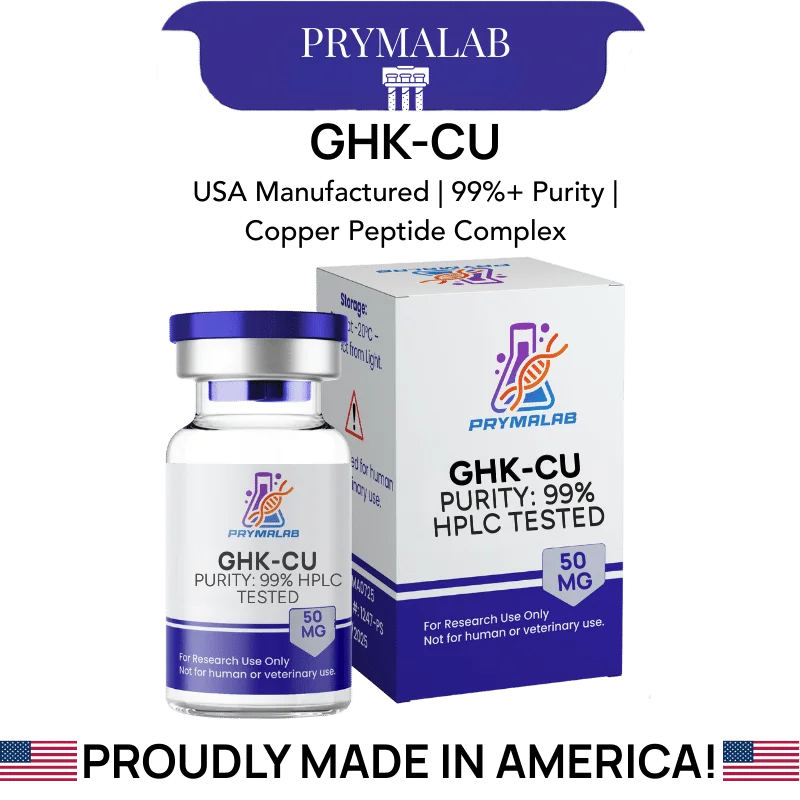
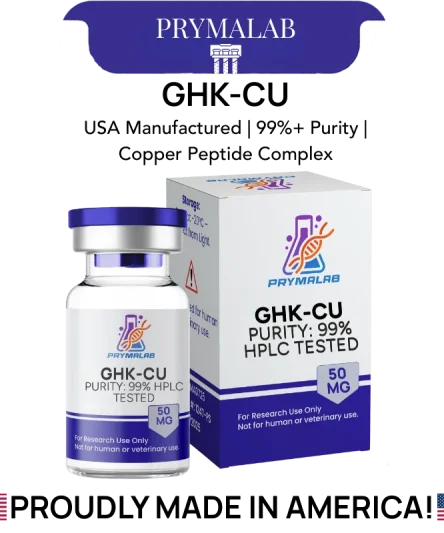
GHK-Cu 50MG Copper Peptide
Glycyl-L-histidyl-L-lysine copper(II) · CAS 89030-95-5 · 50mg lyophilized
GHK-Cu 50mg is a lyophilized vial of glycyl-L-histidyl-L-lysine copper(II), CAS 89030-95-5, molecular weight 401.91. Fifty milligrams corresponds to approximately 124 micromoles, and that figure is the starting point for every dilution calculation this page addresses in detail below.
Specification Table
| Property | Value |
|---|---|
| Compound | GHK-Cu |
| Systematic name | Glycyl-L-histidyl-L-lysine copper(II) complex |
| Alternative designations | Copper tripeptide-1, prezatide copper, Cu-GHK |
| CAS number, copper complex | 89030-95-5 |
| CAS number, free peptide | 49557-75-7 |
| Molecular formula | C14H22CuN6O4 |
| Molecular weight | 401.91 g/mol |
| Amino acid sequence | Gly-His-Lys |
| Vial content | 50 mg lyophilized powder |
| Molar content of vial | Approximately 124 µmol |
| Stock at 1 ml diluent | Approximately 124 mM |
| Stock at 2 ml diluent | Approximately 62 mM |
| Stock at 5 ml diluent | Approximately 24.9 mM |
| Stock at 10 ml diluent | Approximately 12.4 mM |
| Appearance | Blue to blue-violet lyophilized cake |
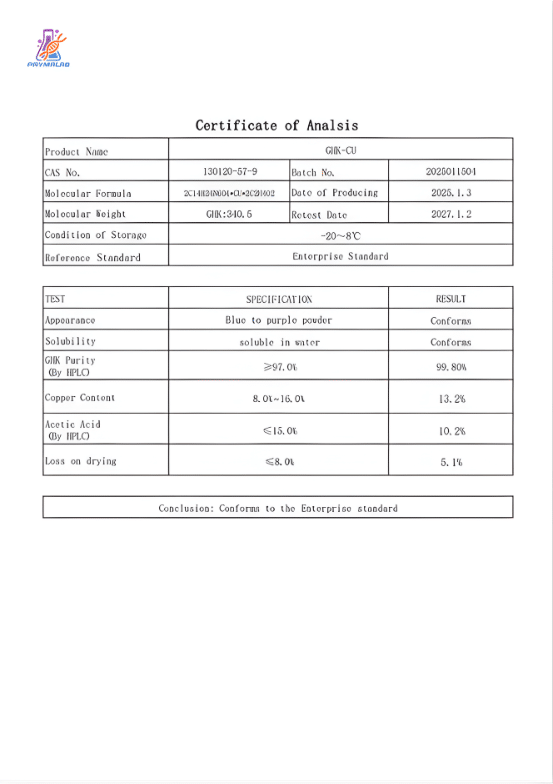
| Purity | Per lot-specific certificate of analysis |
| Solubility | Water soluble. Compatible with bacteriostatic and sterile water |
| Buffer incompatibility | EDTA and other chelators strip copper(II) from the complex |
| Storage, lyophilized | -20°C, protected from light and moisture |
| Storage, reconstituted | 2-8°C, protected from light |
| FDA approval status | None. No approved human or veterinary formulation exists in any jurisdiction |
| Cosmetic use of the peptide | The free peptide appears in topical cosmetic products. That is a separate regulatory category from this material |
How Much Bacteriostatic Water Does a 50mg Vial Need?
This is the most common practical question about GHK-Cu 50mg, and it has no single correct answer, because the right volume depends on the concentration the work requires.
The arithmetic behind GHK-Cu 50mg is fixed. Fifty milligrams divided by a molecular weight of 401.91 gives approximately 124 micromoles. That quantity dissolved in 1 ml produces roughly a 124 millimolar stock. In 2 ml it becomes 62 mM, in 5 ml roughly 24.9 mM, and in 10 ml roughly 12.4 mM.
Choosing between them is a question of how many dilution steps sit between the stock and the working concentration. Published fibroblast activity runs from 10-12 to 10-9 M. Getting from 124 mM to 1 nM is a 124-million-fold dilution. Getting from 12.4 mM to the same endpoint is ten times less, which typically removes one serial step.
Fewer steps means less accumulated pipetting error, so a larger reconstitution volume is generally the better choice for work at the low end of the range. Against that, a more dilute stock takes up more freezer space and loses proportionally more material to container surfaces. Ten millilitres is a reasonable default for most designs, and the decision should be recorded rather than left implicit.
Is GHK-Cu Approved by the FDA?
No. There is no FDA-approved formulation of GHK-Cu for human or veterinary use, and no comparable approval exists in any other jurisdiction. The material supplied here is a research chemical.
The question comes up frequently because of a genuine source of confusion worth addressing directly. GHK and copper-peptide derivatives appear in topical cosmetic products, and cosmetics are regulated under an entirely different framework from drugs. A cosmetic ingredient never has to clear the pre-market safety and efficacy review a drug does. Presence in a face cream is not an approval. It says nothing whatever about injectable or research use.
The distinction matters to anyone reasoning about this compound from a product shelf. Topical cosmetic formulations and lyophilized research material are different products entirely: different regulatory categories, different concentrations, different routes.
What Do the Alternative Names Refer To?
Several designations appear across the literature and commerce, and they do not all mean precisely the same thing.
Copper tripeptide-1 is the International Nomenclature of Cosmetic Ingredients designation, which is why it appears on cosmetic labelling rather than in pharmacology papers. Prezatide copper acetate is the International Nonproprietary Name assigned when the compound was under pharmaceutical development, and the acetate refers to the counterion in that specific salt form.
Cu-GHK and GHK-Cu are both used in the research literature and mean the same thing. The bare term GHK, without the copper designation, refers to the free peptide and should not be used interchangeably with the complex, though papers are not always careful about this.
When searching primary literature, CAS 89030-95-5 is the reliable identifier for the complex and 49557-75-7 for the free peptide.
What Does the Expression Data Cover for GHK-Cu 50mg Research?
The transcriptomic literature is the largest body of recent work on this compound, and it needs reading with some care.
Pickart and Margolina synthesised gene expression data indicating modulation across a wide set of human genes, spanning collagen and glycosaminoglycan synthesis, antioxidant response elements, and metalloproteinase regulation (Pickart and Margolina, International Journal of Molecular Sciences, 2018). Siméon and colleagues had earlier looked at matrix metalloproteinase and tissue inhibitor expression in fibroblast systems (Siméon et al., 2000).
Two cautions apply. First, breadth of transcriptomic modulation invites over-interpretation, since a compound shifting many genes is not necessarily producing a coordinated physiological programme. Second, much of the underlying expression data comes from connectivity-map style analyses, which compare expression signatures rather than measuring direct causation.
That does not make the data uninteresting. It makes it hypothesis-generating rather than confirmatory, which is a reasonable basis for research and a poor basis for claims.
Confirming the Complex Is Intact
Colour is the fastest check available and it is genuinely informative. The blue to blue-violet appearance comes from d-d transitions at the copper(II) centre. Loss of colour means loss of copper. A colourless preparation is free GHK, not the complex.
For quantitative confirmation, ultraviolet-visible spectroscopy resolves the visible absorbance band whose position and intensity report the coordination environment. A shift indicates altered geometry, most often from pH change or a competing ligand in the buffer.
Mass spectrometry confirms identity but requires care with a metal complex, since ionisation conditions can strip the copper and return the free peptide mass. A method validated for metallopeptides gives a more reliable answer than a default peptide method.
What Should a Certificate of Analysis Show?
For a metal-peptide complex the certificate needs to establish more than it would for a plain peptide, and knowing what to look for is worth a few minutes before purchase.
Peptide purity measured by high-performance liquid chromatography is the baseline figure that every supplier quotes. It describes the proportion of peptide-related material that is the intended sequence, and it says nothing whatsoever about the copper.
Copper content is the figure that actually matters here, and it is frequently absent from the certificate. Determined by atomic absorption spectroscopy or inductively coupled plasma methods, it establishes stoichiometry. A preparation at 0.7 copper per peptide is not the same material as one at 1.0, and the difference will not appear in an HPLC purity number.
Counterion identity feeds directly into the mass calculation. Acetate and chloride salts have different formula weights, so a milligram of one contains a different molar quantity of active complex than a milligram of the other.
Water content by Karl Fischer titration matters for any lyophilized powder. Residual moisture inflates apparent mass, so a weighed milligram delivers less peptide than it appears to.
A certificate showing all four tells you as much about the supplier as it does about the lot.
Why the Format Choice Is Worth Deciding First
Reconstitution volume is the one decision on this page that cannot be revisited. Once diluent goes into the vial, the stock concentration is fixed and every downstream calculation inherits it.
That makes GHK-Cu 50mg unusual among research purchases in that the most consequential handling decision happens in the first thirty seconds. Deciding it against the working range the study actually needs, rather than against whatever volume is convenient, is the single cheapest improvement available.
Write the intended stock concentration onto the vial label before anything goes in. It takes moments and it blocks the commonest error, which is reconstituting to a round volume and then discovering the serial dilution to the working range needs one more step than the bench has tubes for.
Reconstitution and Storage in Laboratory Practice
Introduce diluent slowly down the vial wall, then swirl until the cake clears. Do not shake. Record the volume used at the moment it is used, because the stock concentration derived from it propagates through every subsequent calculation.
Keep the material dark. Copper(II) complexes are photosensitive, and copper can drive reactive oxygen chemistry under illumination, so amber vials or foil are standard rather than optional here.
Lyophilized material sits at -20°C away from light and moisture. Reconstituted solution goes to 2-8°C in the dark, aliquoted before freezing to avoid repeated freeze-thaw. Any loss of colour, cloudiness or visible particulate is a reason to discard and log rather than to proceed.
Published Literature
Checked against publisher records and primary indexes before inclusion. The 2000 Life Sciences paper covers the metalloproteinase work cited in the expression section.
- Maquart FX, Pickart L, Laurent M, Gillery P, Monboisse JC, Borel JP. FEBS Letters. 1988;238(2):343-346. DOI: 10.1016/0014-5793(88)80509-X
- Pickart L, Margolina A. International Journal of Molecular Sciences. 2018;19(7):1987. PMID: 29986520
- Pickart L, Vasquez-Soltero JM, Margolina A. BioMed Research International. 2015;2015:648108.
- Pickart L, Thaler MM. Nature New Biology. 1973;243(124):85-87.
- Siméon A, Emonard H, Hornebeck W, Maquart FX. Life Sciences. 2000;67(18):2257-2265.
Frequently Asked Questions
How much bac water for 50mg GHK-Cu?
It depends entirely on the working concentration the study needs, which is why no single number is correct. Fifty milligrams is approximately 124 micromoles, so 1 ml yields roughly 124 millimolar, 5 ml roughly 24.9, and 10 ml roughly 12.4. Ten millilitres is a sensible default. It removes a serial step for picomolar work.
Is GHK-Cu FDA approved?
No, and no comparable approval exists in any other jurisdiction either, for human or for veterinary use. GHK derivatives do appear in topical cosmetic products, but cosmetics sit under a separate framework requiring no pre-market approval for safety or efficacy. Presence in a face cream is not an approval.
Why does reconstitution volume affect accuracy?
Because pipetting error compounds multiplicatively rather than additively across serial dilution steps, so each additional step widens the uncertainty on the final concentration. Reaching 1 nanomolar from 124 millimolar is a 124-million-fold dilution. From 12.4 millimolar it is ten times less, which usually removes one step entirely.
What is prezatide copper acetate?
The International Nonproprietary Name assigned during pharmaceutical development, where acetate identifies the counterion in that particular salt form. Copper tripeptide-1 is the separate cosmetic ingredient designation. Both point to the same complex described here.
Is GHK-Cu 50mg the same compound as the 100mg vial?
Yes, identical material at a different fill weight, and the practical difference lies entirely in the reconstitution arithmetic rather than in the chemistry. Fifty milligrams is approximately 124 micromoles against roughly 249 for the larger vial. The smaller format reaches a given working concentration with fewer extreme dilution steps.
What is the difference between GHK and GHK-Cu?
GHK is the free tripeptide at CAS 49557-75-7. GHK-Cu is that same peptide carrying a coordinated copper(II) ion bound through the histidine imidazole, the terminal amine and a backbone amide nitrogen, registered separately at CAS 89030-95-5. Published assays report different behaviour for the two.
Can mass spectrometry confirm the complex?
It confirms identity, though with a caveat that catches people out. Ionisation conditions can strip the copper and return the free peptide mass, which looks like an entirely different compound. Use a method validated for metallopeptides rather than a default peptide method.
What does the gene expression research establish?
It reports modulation across a wide set of human genes spanning collagen and glycosaminoglycan synthesis, antioxidant response elements and metalloproteinase regulation. Much of the underlying data comes from connectivity-map style signature comparison rather than direct causal measurement. That makes it hypothesis-generating.
Why must EDTA be avoided?
EDTA binds copper(II) more tightly than the tripeptide can, so it pulls the metal out of the complex and leaves free GHK alongside a copper-EDTA species. Since published activity is attributed to the intact complex, a chelator in the buffer can silently invalidate an entire experiment.
How should the vial be stored?
Lyophilized at minus 20 Celsius, sealed against light and moisture, with reconstituted solution at 2 to 8 Celsius in the dark and aliquoted before the first freeze. Light protection is not optional here. Copper(II) complexes are photosensitive and copper drives reactive oxygen chemistry under illumination.
What should a certificate of analysis include for this compound?
Four things. Peptide purity by chromatography, copper content by elemental analysis to establish stoichiometry, counterion identity because it changes the formula weight, and water content by Karl Fischer titration because residual moisture inflates apparent mass. Certificates showing all four are a good signal about the supplier.
Why is peptide purity alone insufficient here?
Because it describes only the proportion of peptide-related material that is the intended sequence. It says nothing about how much copper is present or whether the complex is fully formed, and for a metal-peptide complex that is the property the published activity depends on.
Does counterion identity affect calculations?
Yes. Acetate and chloride salts carry different formula weights, so a milligram of one delivers a different molar quantity of active complex than a milligram of the other. Where the certificate does not state the counterion, molar calculations carry an unquantified error.
Compliance Statement
GHK-Cu 50mg is sold exclusively for laboratory research use. It is not a drug, food, or cosmetic product, and it is not a dietary product of any kind. It is not approved by the FDA or any comparable authority for human or veterinary use. This product is not intended to diagnose, treat, cure, or prevent any disease. It must not be given to humans or animals. Purchase is restricted to qualified researchers and institutions operating within applicable laws. All handling is the responsibility of the purchasing laboratory.
Other formats of GHK-CU
GHK-CU is also stocked as GHK-Cu Nasal Spray, GHK-CU 50mg/ml preloaded 3ml pen and GHK-CU 100MG. Each listing states its own quantity and concentration, and the pen and vial comparison explains what changes between formats.









20 reviews for GHK-CU 50MG